The Global Debt System: Risks, Markets and Recovery
Following the structural expansion of global debt and the end of cheap money explored in the previous articles as part of the Macro Landscape, a key question emerges: where is this debt concentrated?
Understanding which countries carry the highest levels of debt is essential to assessing global risk, financial stability and the challenges of managing and recovering value across borders.
Mapping global indebtedness
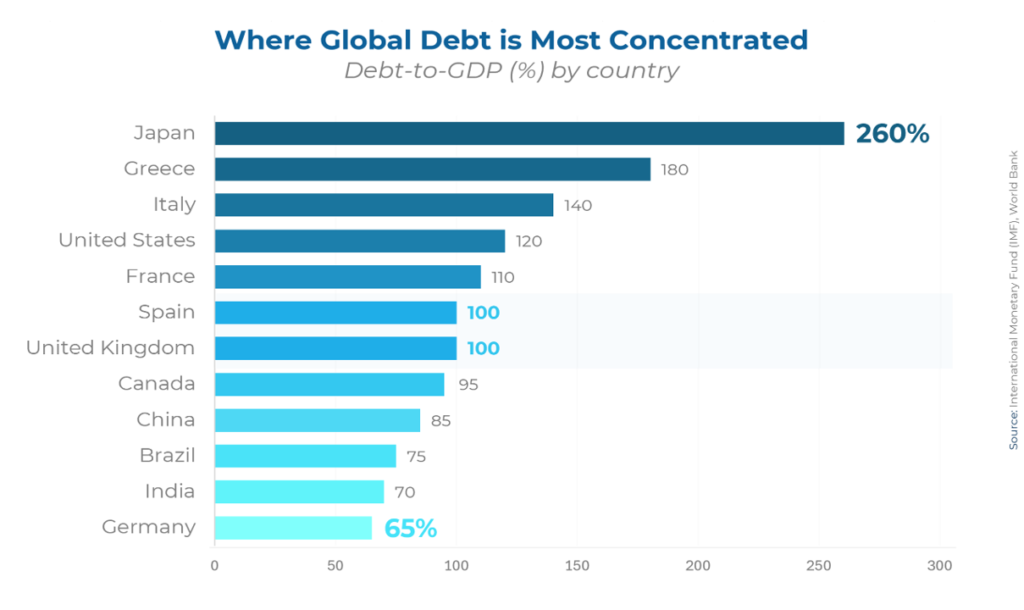
Global debt is not evenly distributed. While total levels continue to rise, certain economies carry a disproportionate share, either in absolute terms or relative to their economic output.
Advanced economies tend to hold higher absolute levels of debt, supported by deeper capital markets and greater access to financing. At the same time, several countries also present elevated debt-to-GDP ratios, which can signal structural vulnerability depending on growth and fiscal conditions.
The most indebted economies
The United States, China and Japan represent the largest shares of global debt in absolute terms, reflecting the size and depth of their economies.
In relative terms, however, countries such as Japan, Italy and Greece stand out with significantly higher debt-to-GDP ratios, indicating more limited flexibility in managing fiscal pressure.
This distinction between absolute and relative debt is essential. Larger economies may sustain higher debt due to scale and market confidence, while others face greater risk even at lower levels of total debt.
Debt concentration and global risk
High levels of debt concentration increase systemic risk. When large economies carry significant debt, changes in interest rates, growth expectations or investor confidence can have global effects.
At the same time, countries with weaker fiscal positions are more exposed to external shocks, particularly in a higher interest rate environment. This creates a more fragile and interconnected system, where local imbalances can quickly translate into broader financial stress.
Implications for cross-border risk and recovery
From a practical perspective, the distribution of debt directly impacts cross-border financial operations. Different legal systems, currencies and economic conditions create varying levels of complexity when managing and recovering financial exposures. As a result, the same debt can present very different risk profiles depending on where it is located.
As debt becomes more concentrated and financial conditions more restrictive, these challenges intensify, making international debt collection increasingly complex and strategically important. Recovering value across borders requires not only speed, but also coordination and local understanding, as delays, legal barriers and currency fluctuations can significantly affect outcomes.
Organisations operating globally with strong local execution are better positioned to navigate these differences, structuring more effective and coordinated recovery processes across jurisdictions, while reinforcing security and trust in international business relationships.
Conclusion
The distribution of global debt reveals a system that is both concentrated and uneven, where risk is shaped not only by how much debt exists, but by where it is located and how it is structured across different markets.
In a world of higher borrowing costs and increasing complexity, these differences become more critical. Managing financial exposure is no longer only about understanding volumes, but about navigating jurisdictions, currencies and legal frameworks that directly impact outcomes. In this context, organisations such as TCM Group, combining global reach with strong local execution, are better positioned to manage these complexities and support more consistent results across markets.
In practice, preserving value across borders requires more than financial strategy. It demands speed, coordination and the ability to operate effectively at a local level while maintaining a global perspective.
In a global system defined by rising debt and increasing complexity,
value is no longer determined only by how credit is extended,
but by how efficiently it is managed, coordinated and recovered across borders.