The Global Debt System: Risks, Markets and Recovery
Following the sharp rise in global debt explored in the first article within the #MacroLandscape, another major shift is now changing the financial landscape. For more than a decade, money was cheap and easy to access. That has now changed. This shift is affecting how debt is financed, managed and collected across the global economy.
From abundant liquidity to tighter conditions
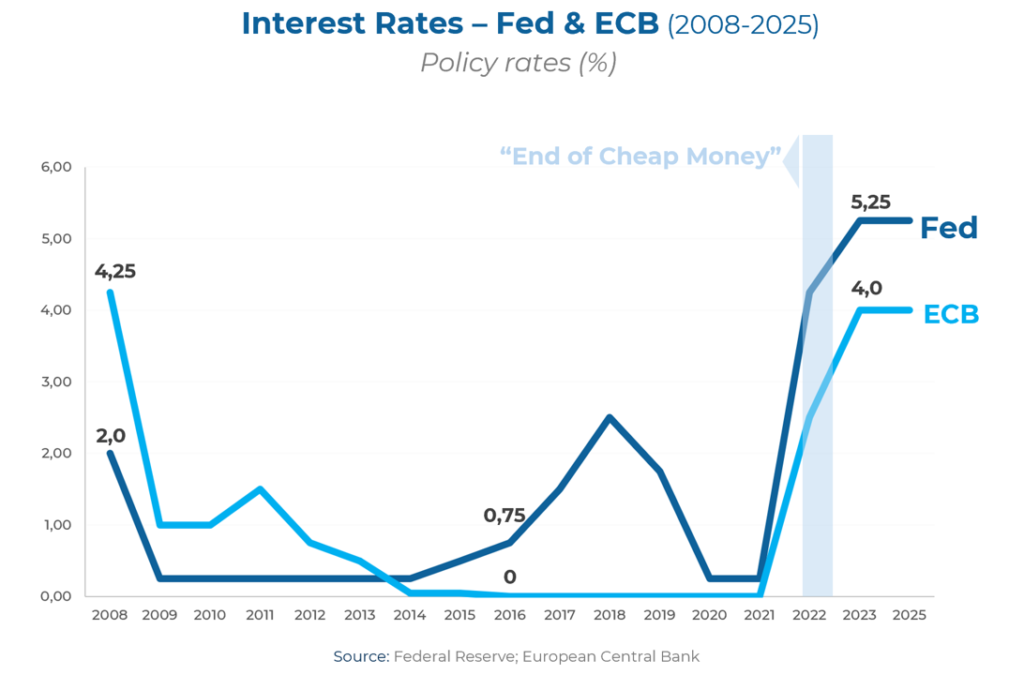
After the 2008 financial crisis, global economies entered a long period of low interest rates and high liquidity. Central banks such as the Federal Reserve and the European Central Bank kept borrowing costs low to support growth and stabilise markets.
This made credit widely available. Governments increased spending, companies took on more debt, and markets adapted to a world where financing was inexpensive. Over time, this environment supported a rapid increase in global debt.
The turning point: inflation and rising rates
This situation changed quickly after the pandemic, as rising inflation forced central banks to act. Interest rates increased across major economies and liquidity became more limited, marking a clear shift from the conditions that had supported growth for over a decade, as shown in the chart below.
What had been a supportive environment has now become more restrictive. Borrowing is more expensive, and access to capital is no longer as easy or predictable as before.
The rising cost of debt
As interest rates rise, the cost of servicing debt increases. In a system already highly leveraged, this creates pressure across the board.
From our perspective, this change is not only financial, but also operational. As conditions tighten, we see a growing need for faster and more structured ways to manage financial exposure, especially across borders.
Companies face higher refinancing costs, governments deal with more pressure on public finances, and households have less flexibility. Debt that once seemed manageable can quickly become difficult to sustain.
Pressure on credit and financial stability
Higher borrowing costs and tighter liquidity are introducing new risks across the system, increasing default pressure and leading lenders to adopt a more cautious approach. These effects are even more pronounced in cross-border environments, where currency movements, legal differences and regulatory changes can quickly affect both the value and the recoverability of financial assets.
In practice, this shift is already visible. Managing international exposures has become more complex, and timing is now a critical factor in preserving value, as delays can significantly reduce recovery outcomes in an increasingly volatile environment.
Implications for global debt collection
As financing becomes more expensive and credit conditions tighten, international debt collection becomes increasingly critical. Recovering value efficiently is no longer optional, and acting late can significantly reduce outcomes, especially in cross-border cases where complexity is higher.
Collection is no longer a secondary activity. It becomes a core part of financial strategy. Organisations such as TCM operate in this space by combining global reach with local expertise. This allows for faster and more coordinated collection processes, adapted to each market. In a more volatile environment, this approach helps preserve value and improve results.
In a world where money is no longer cheap, recovery is no longer optional. It is essential.
Conclusion
The end of cheap money marks a clear turning point in the global debt system, where higher borrowing costs and tighter liquidity are reshaping how debt is managed, sustained and ultimately collected. What was once a more flexible environment has become more constrained, increasing both the complexity and the urgency of financial decisions.
In this new reality, preserving value depends on the ability to act quickly, coordinate across borders and adapt to local conditions, particularly as risks become more interconnected and less predictable.
Organisations with global structure and strong local execution are better positioned to navigate this shift, supporting more effective outcomes in international collection and helping to manage the growing pressure created by a world where money is no longer cheap.
In a global system defined by rising debt and increasing complexity,
value is no longer determined only by how credit is extended,
but by how efficiently it is managed, coordinated and recovered across borders.