The Global Debt System: Risks, Markets and Recovery
This article marks the beginning of the series #TheGlobalDebtSystem, which examines how debt has evolved into a central force shaping the global economy. The series is structured across three interconnected dimensions:
· Macro Landscape explores the structural expansion of global debt and its economic implications.
· Market Dynamics analyses how this debt is distributed and exposed to risk across financial systems.
· Recovery & Business focuses on the practical challenges of preserving value through international debt collection, particularly in complex cross-border environments.
Together, these perspectives aim to provide a comprehensive view of how debt is created, how it behaves, and how value is ultimately preserved or lost.
The Age of a Permanent Debt
The global economy is not simply more indebted. It has entered a new structural phase: the age of permanent debt. Over the past two decades, debt has evolved from a tool used at specific points in the economic cycle into a continuous component of how the system operates. Growth no longer occurs in spite of debt; it increasingly depends on it.
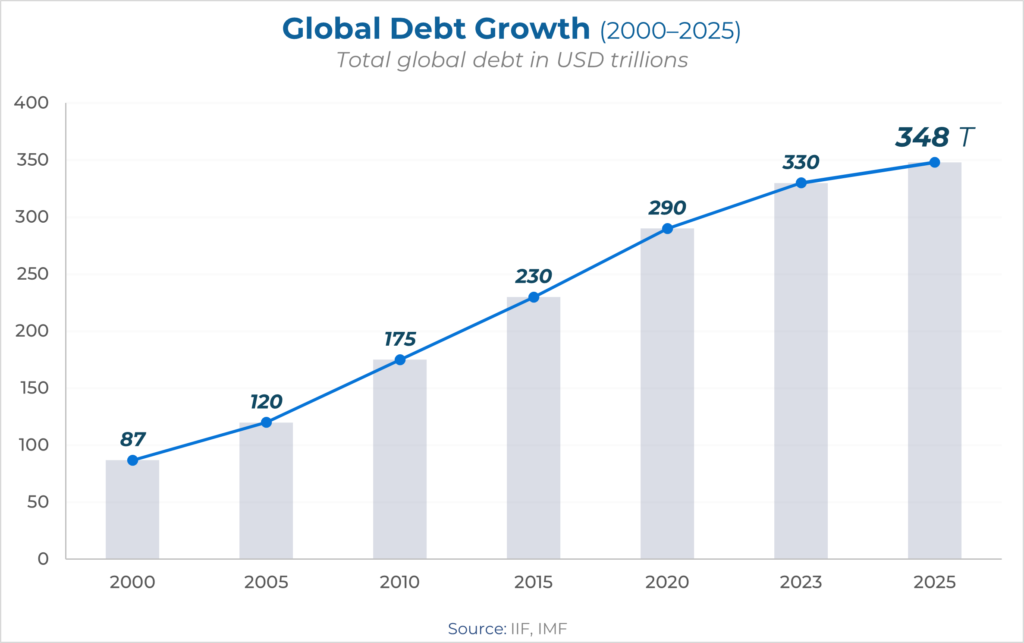
At the beginning of the 2000s, global debt stood at approximately $87 trillion. By 2025, it has reached nearly $348 trillion. This expansion reflects more than financial growth. It signals a structural shift in the architecture of the global economy, where debt is no longer temporary, but embedded in the system itself.
A system dependent on debt
This transformation is evident across all economic actors. Governments rely on sustained borrowing to support fiscal policy and economic stability, corporations use leverage as a permanent strategy for expansion, and households increasingly depend on credit as an extension of income.
At the same time, debt has grown faster than the real economy and now represents approximately 235% to 240% of global GDP. This indicates a system that depends on continuous refinancing to remain stable, reducing its margin for error. The central challenge is no longer access to credit, but the ability to sustain and manage debt over time.
Structural fragility in a volatile environment
Such a system inevitably becomes more sensitive to shocks. In a highly leveraged environment, even moderate changes in interest rates, liquidity conditions, or investor confidence can generate disproportionate effects. Economic stability becomes increasingly dependent on external variables, including monetary policy shifts, capital flows, and geopolitical developments.
This fragility is amplified in cross-border exposures. Currency volatility, legal differences, and regulatory uncertainty can quickly affect both the value and the recoverability of financial assets, transforming what was once a manageable exposure into a complex and time-sensitive situation.
Recovery as a core financial function
In this context, credit collection becomes a central component of financial strategy. The discussion is no longer limited to credit origination, but extends to the ability to recover value efficiently, particularly in international environments. Processes involving global debt collection require not only technical expertise, but also local execution capabilities and a deep understanding of jurisdiction-specific dynamics.
Organisations such as TCM operate within this space by combining global structure with locally aligned execution. This approach enables financial exposures to be converted into effective recoveries, reinforcing the importance of scale, coordination, and market-specific expertise in cross-border collection processes.
Time as a strategic variable
In a system defined by high leverage and volatility, time becomes a critical factor. Delays in collection actions tend to reduce recovery outcomes, as asset quality deteriorates, legal complexity increases, and macroeconomic conditions evolve. What initially appears as a recoverable position can quickly shift into a distressed or non-performing exposure.
This dynamic reinforces a clear principle. In a global environment characterised by permanent debt and structural volatility, acting early is essential to preserving value.
Conclusion
The global economy now operates within a system where debt is structural and persistent, requiring not only access to capital but the ability to manage and collect it effectively across increasingly complex and cross-border environments.
As global indebtedness continues to expand, so does the importance of robust international debt collection capabilities, able to operate across jurisdictions, currencies, and regulatory frameworks. In this landscape, preserving value depends on operational scale, international coordination, and execution aligned with local realities.
Organisations such as TCM play a key role in this context. With a consolidated global structure and strong operational presence across multiple markets, TCM combines international reach with local expertise, enabling more efficient and structured collection processes in complex environments.
In a global system defined by rising debt and increasing complexity,
value is no longer determined only by how credit is extended,
but by how efficiently it is managed, coordinated and recovered across borders.